- Solomon's Circle
- Posts
- Pasture-Raised Christians
Pasture-Raised Christians
America's Bold Move in Venezuela: Energy and Freedom; The Food Pyramid Has Been Flipped Upside Down!

Solomon's Circle
January 15, 2026
Devotional
Pasture-Raised Christians
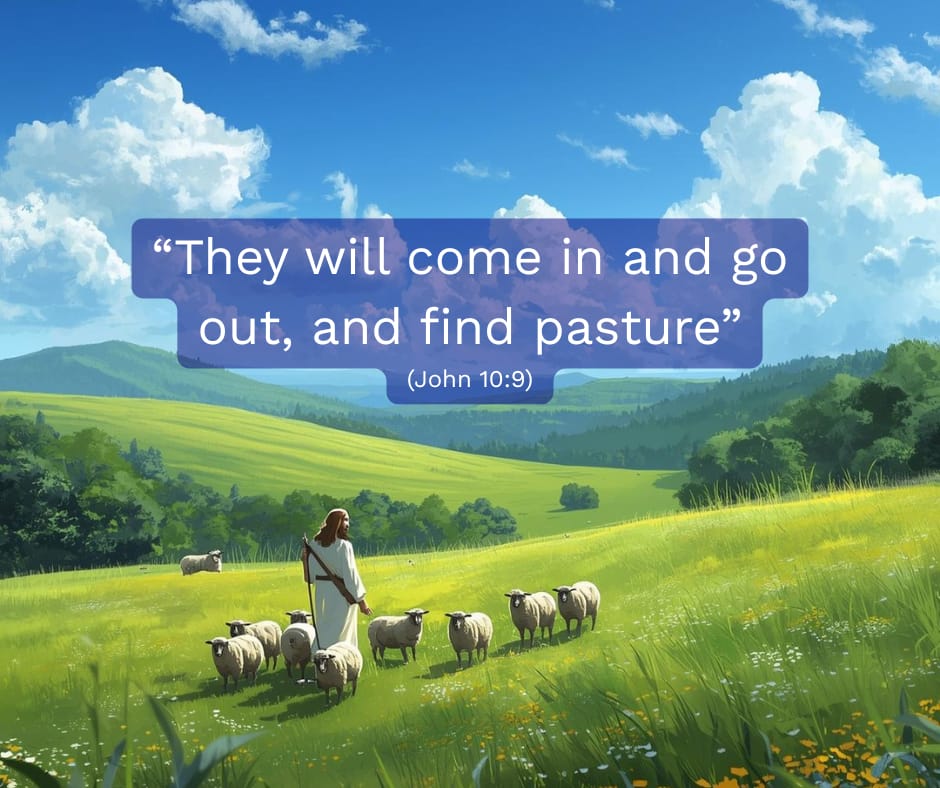
When reading John Chapter 10, Jesus describes himself as both the Gate of the sheep pen and the Good Shepherd. What caught my attention was the fact that the sheep, those that follow Christ, are called to be in the pasture…..
“The gatekeeper opens the gate for him, and the sheep listen to his voice. He calls his own sheep by name and leads them out. When he has brought out all his own, he goes on ahead of them, and his sheep follow him because they know his voice.”
“I am the gate; whoever enters through me will be saved. They will come in and go out, and find pasture.”
Yes, we do enter the Gate, Jesus, to receive salvation, but then He leads us out into the pasture as we listen to and follow His voice. We are called to be pasture raised!
If you pursue healthy eating, you are familiar with the benefits of pasture-raised meat that are nourished naturally rather than through processed feed that’s void of good nutrition.
In researching pasture-raised sheep, I learned they live in the pasture the majority of their lives. They are only penned 5-20% of the time for lambing, severe weather or handling. So why this info on sheep raising you ask?
The pen is a place of safety and comfort and easy food. Certainly, where we would all prefer to dwell. That may just be the comfort of your church or home.
Yet, God intends for us to spend the majority of life in the wild open pasture of the world. Yes it's dangerous and full of ravenous wolves, but if we follow Jesus, he guides and protects us as well described in Psalm 23. What's more is He directly nourishes us with His Word which is all natural.
So, as you are kicking off the new year, I encourage you to step out of your comfort zone, follow Jesus where He leads you as you listen to His voice, and don’t be intimidated by the world.
Live boldly and free as a pasture-raised Christian!
Financial Update
America's Bold Move in Venezuela: A New Era for Energy and Freedom
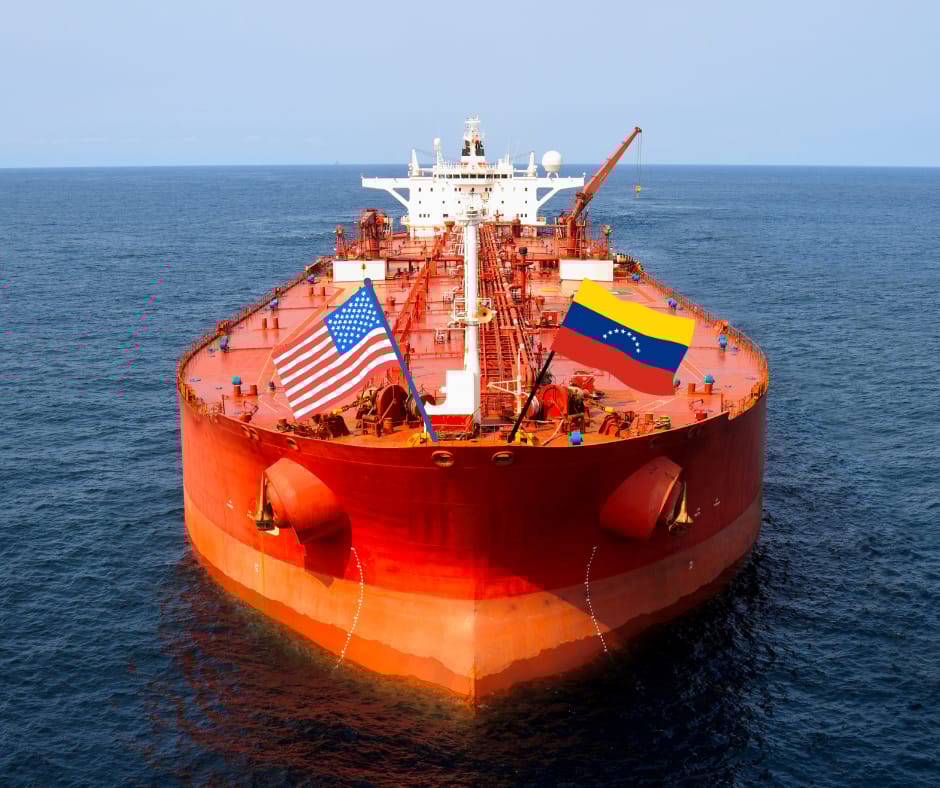
On January 3, 2026, the United States took decisive action in Venezuela, capturing President Nicolás Maduro and potentially unlocking one of the world's greatest untapped energy resources.
This isn't just about oil—it's about America reclaiming its position as the world's energy leader while offering hope to millions of Venezuelans who've suffered under decades of mismanagement.
Late last year, we published a brief article on oil and why it could potentially be a good play in the near future. With an expected increase in oil production and sales on the horizon, one would think that would equate to a decline in the current oil prices, although that is yet to be determined.
Venezuela's Staggering Oil Potential
Venezuela sits on the world's largest proven oil reserves—303 billion barrels, representing 17% of the entire global total. To put that in perspective, Saudi Arabia has 267 billion barrels European Central Bank, Russia has 80 billion, and the United States has 38 billion. Venezuela literally has more oil than any country on Earth.
Despite these massive reserves, Venezuela ranked just 21st in oil production in 2024, pumping only about 960,000 barrels per day. Compare that to the U.S. producing 11.6 million barrels daily, Russia's 10.5 million, and Saudi Arabia's 10.2 million.
Venezuela's production collapsed from 3 million barrels per day in 1999 to under 0.5 million in 2020. That's a 90% drop. All that wealth, just sitting there unused while Venezuelans struggled.
Why America Acted
The U.S. Justice Department indicted Maduro on cocaine-trafficking conspiracy charges back in March 2020, and Secretary of State Marco Rubio characterized this as a law enforcement action to recover a fugitive U.S. Energy Information Administration official.
President Trump also noted that Maduro had "stolen" U.S. oil assets when Venezuela nationalized its oil reserves in the 1970s, forcing out American companies U.S. Energy Information Administration, which had invested billions in developing those fields.
Beyond law enforcement, there's the humanitarian angle. Venezuelans have endured economic collapse, hyperinflation, and food shortages while sitting atop the world's richest oil reserves. Sometimes stepping in to help isn't just the right thing to do—it's necessary.
”… to proclaim the year of the Lord’s favor and the day of vengeance of our God, to comfort all who mourn, and provide for those who grieve in Zion— to bestow on them a crown of beauty instead of ashes, the oil of joy instead of mourning, and a garment of praise instead of a spirit of despair.”
Trump said that as the U.S. helps run Venezuela, it will fix the country's "badly broken" oil infrastructure and improve its petroleum refining and extracting operations.
Returning Venezuela to its early 2000s production levels of around 3 million barrels per day would require about $180 billion in investment through 2040.
Trump emphasized that American oil companies would invest billions and "use that money in Venezuela," claiming "the biggest beneficiary is going to be the people of Venezuela," along with Venezuelan ex-pats in the U.S.
Crumbling infrastructure rebuilt, jobs created, and an economy revitalized. Venezuelans could finally benefit from their own natural resources instead of watching them waste away under corruption and incompetence.
A Strategic Win
Just four countries—Venezuela, Saudi Arabia, Iran, and Canada—control over half of the world's proven oil reserves.
With this move, America strengthens its position in global energy markets while potentially bringing prosperity to a nation that's suffered far too long. Lower prices at home, stronger strategic positioning abroad, and hope for millions of Venezuelans—that's the potential of this bold decision.
Health Nuggets
EAT REAL FOOD - The Food Pyramid Has Been Flipped Upside Down!
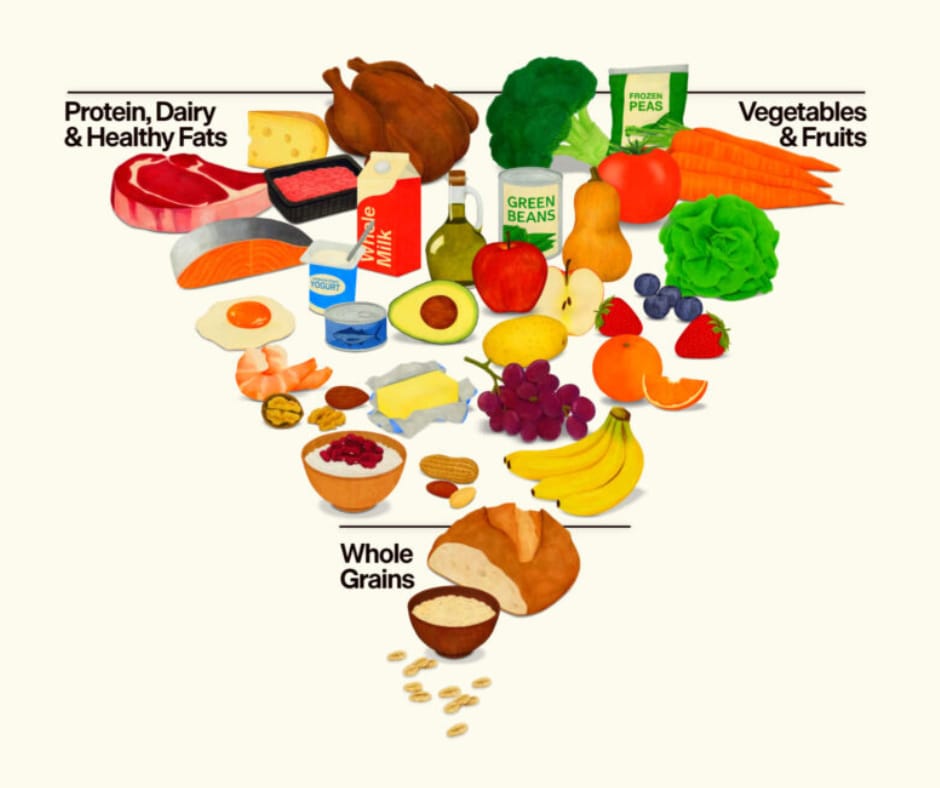
The inverted triangle food pyramid in the U.S. has a “new” emphasis on protein, dairy, healthy fats, and fruits/vegetables, with grains as the smallest category. It also strongly discourages highly processed, sugary foods and focuses on “real food”. Now, let’s dig in!
Overall structure
The graphic is an upside-down pyramid: the broad top represents foods to eat the most, and the narrow bottom represents foods to eat the least.
At the top, two large sections share priority:
Protein/dairy/healthy fats
Vegetables and fruits
At the bottom tip are whole grains, shown as the smallest daily share.
What it tells you to eat more of
“High-quality” protein at most meals, including eggs, poultry, seafood, red meat in moderation, and plant proteins like beans, nuts, and seeds.
Full-fat dairy is now explicitly allowed and even favored over the low-fat/fat-free options, within an overall limit on saturated fat (about 10% of calories).
Healthy fats from whole foods (good quality olive oil, nuts, seeds, avocado, animal fats in moderation), rather than industrially processed oils.
Plenty of vegetables and fruits, with extra emphasis on high-fiber and fermented to support gut health.
What it tells you to limit
Highly processed foods (packaged snacks, sugary drinks, fast food, many frozen meals), which are explicitly “named and shamed” for chronic disease risk.
Added sugars - especially in drinks, breakfast cereals, desserts, and flavored yogurts.
Refined grains (white bread, many pastas, pastries); when you do eat grains, choose whole grains in small amounts.
How this differs from the old pyramid/MyPlate
Old guidance put grains at the base and often pushed low-fat or fat-free dairy and lean meats; the new pyramid flips that, shrinking grains and restoring prominence to protein and good fats.
Instead of “low fat, more carbs”, the new message is closer to “more protein and real-food fats, fewer refined carbs and ultra-processed foods”.
It comes with a simple “eat real food” slogan and shorter, more consumer-friendly guidelines than the older, more technical documents.
Simple day-to-day takeaway
Build most meals around a protein source and plenty of vegetables/fruits, add some healthy fat, and include a small portion of whole grains, if desired.
Minimize foods that are sugary, highly processed, or based mostly on refined starches (chips, sweets, white bread, many packaged snacks).
Let’s make the new year 2026, A HEALTHIER ONE!
Happy New Year!
“He makes grass grow for the cattle, and plants for people to cultivate— bringing forth food from the earth.”
Note: Health Nuggets are opinions and not medical advice.
Trivia Corner
Test your knowledge of the Bible.
In the Gospel of John, Jesus refers to himself using seven ‘I AM’ statements that include all but one of these: |
Subscribe for free and Share with Friends
Join a vibrant community of Christians pursuing God’s wisdom for life and business. Receive Solomon’s Circle newsletter directly to your inbox weekly:

A big 2026 starts now. True builders use this stretch of time to get ahead, not slow down. Launch your website with AI, publish a stunning newsletter, and start earning more money quickly through the beehiiv Ad Network. Use code BIG30 for 30 percent off your first three months. Start building for 30% off today.
Take Care and God Bless!
Solomon’s Circle
Reply